
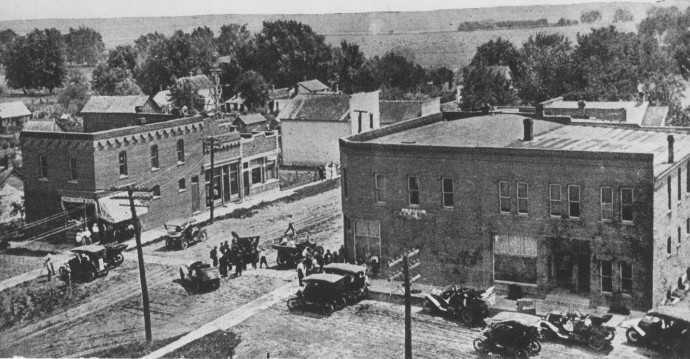
By the summer of 1916 the year-old Egyptian Trail was no longer a novelty, it was a reality. Local papers now turned to reporting news of improvements being made to the roads along the trail. The Daily News (May 3) noted that Friday, May 13 was to be observed as “Good Roads Day” and that local highway commissioners “along the trail and in other sections of the county” would participate “by dragging and otherwise improving the highways.”
In the days before paving, the biggest issue with these rural dirt roads was dust during the dry times and mud during the wet. By 1917 these problems were being addressed by applying a layer of oil to mitigate the dust and compact the roadbed. Roads were also dragged and graded to smooth the surface and allow better water runoff into side ditches.
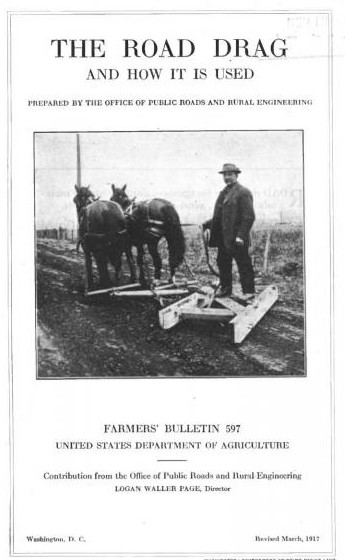
Local news reported oiling and grading was being undertaken on the roads in Rantoul, Somer, and Champaign townships that summer, noting “oil is regarded as the best material to use until a real hard road can be built” (Daily News, August 16). By October, the Courier reported (October 3) that “34,000 gallons of oil [had] been ordered to cover the trail from “the Champaign limits to the northern limits of Somer township.”
The article also noted that “Rantoul [would] oil a strip of the road nine and two tenths miles long, to connect the Somer township road to Rantoul city” and that “citizens on the proposed route offered to pay 50 per cent of the cost of oil if the commissioners will pay the other 50 per cent and the cost of applying it.”
State Funding Paves the Way for Change
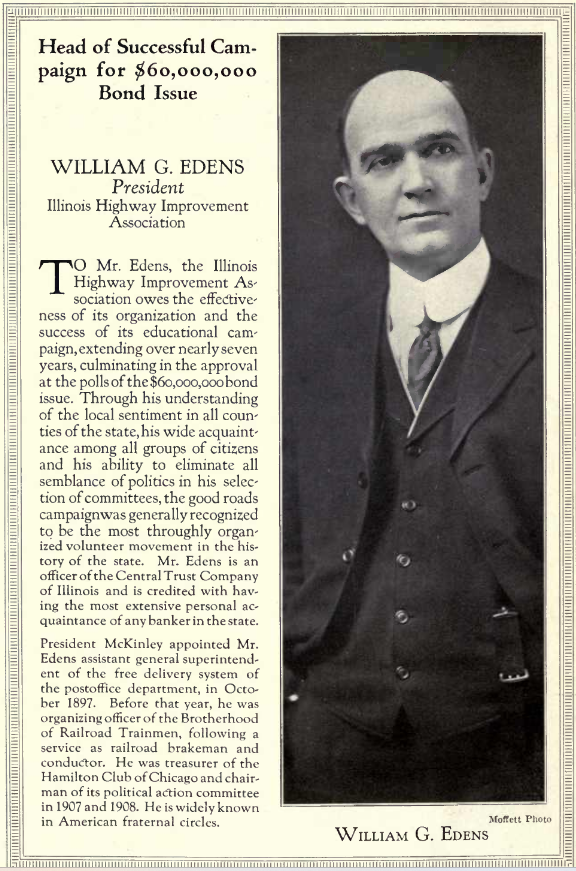
Reports of the continued oiling of sections of the trail appear through the end of 1919. At the same time, calls for permanent paving and potential route shifts began to appear. The biggest boost for better roads came in 1918 when a referendum to issue $60 million in bonds for road improvement and the development of a state highway system was passed by Illinois voters. The man credited for the bond issue’s success was William G. Edens (below), president of the Illinois Highway Improvement Association.
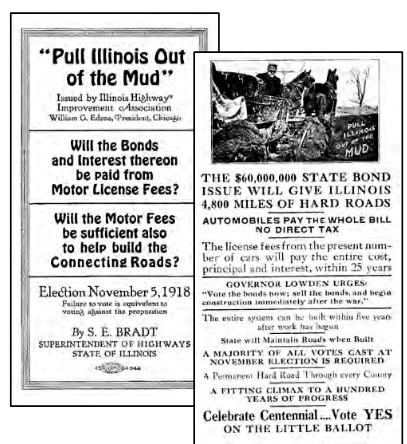
In response to the referendum’s passage, the Courier (December 19) wasted no time reviving the idea that the Egyptian Trail, which was set to become a state highway under the improvement plan, should be routed through Urbana rather than Champaign.
“Urbana does not stand a ghost of a show for getting that bond issue road she is after unless she can show plans are under way for paving [Cunningham] avenue, when the state highway commission gets here to look the situation over,” the Courier editors asserted. “Urbana has objected to the proposed road coming down along the Egyptian trail from Rantoul to Champaign, as provided for in the preliminary survey, pointing out that the Cunningham avenue road is the logical route, both from a topographical and economical standpoint . . . .”
Urbana advocates were not alone in seeking an alternative route for the Egyptian Trail. The Daily News (January 24, 1919) reported on an effort to “change the location of the proposed hard road between Pesotum and Tuscola” and noted that “a petition is being circulated to that effect.” Supporters wanted the road to be shifted to the east side of the railroad tracks from path the Egyptian Trail followed west of the tracks, making the route “fully a mile shorter by actual measurement” and “much more advantageous to the people of the Villa Grove vicinity.”
The first pavement on rural portions of the Egyptian Trail came in the form of bricks, laid along the route out of Champaign toward Savoy. The Courier reported (May 19) on a contract that would use “state road aid” funds for the section “southward from the Savoy road pulling out of Champaign, for a distance of 5,552 feet, [that] extends the brick pavement of the Egyptian trail almost to Savoy, five miles out of Champaign.”
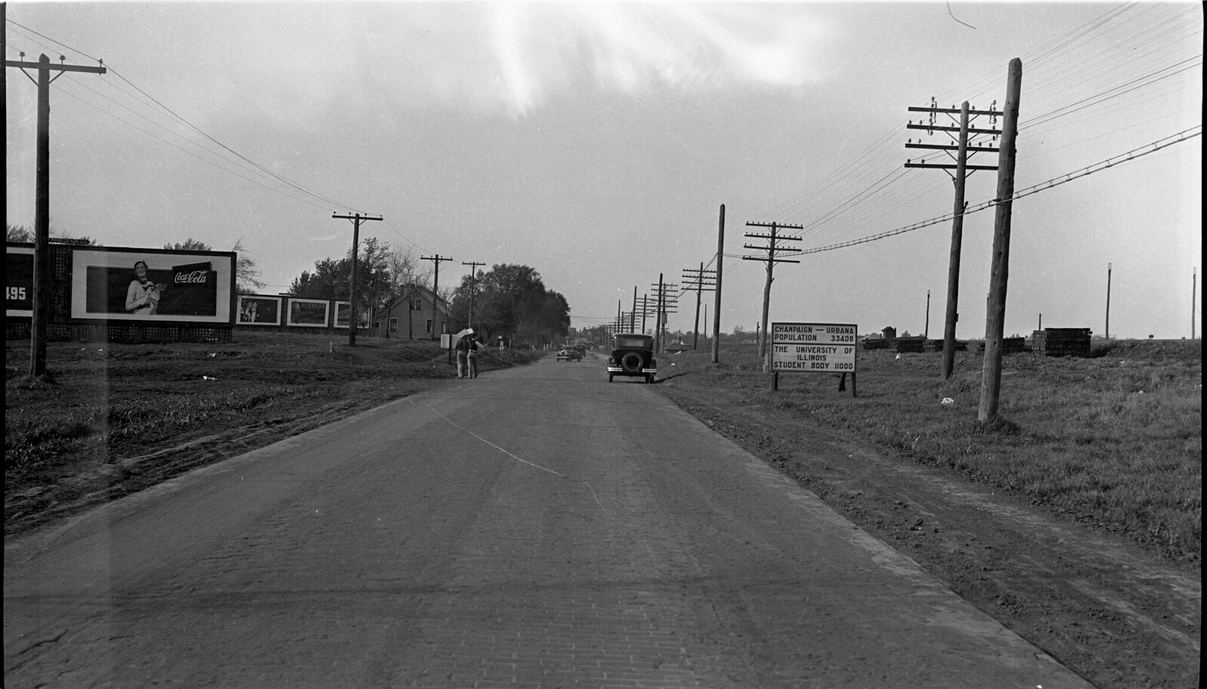
Efforts to secure funds for local projects from the $60 million bond issue continued through the summer of 1919. The Courier reported (June 27), “Twin City men have been diligently at work for several weeks, endeavoring to induce the state highway superintendent’s office to get busy and endeavor if possible to get at least a portion of the Egyptian trail, so far as Champaign county is concerned, improved this year.” By this time, “improvements” had become synonymous with “paving,” and so-called “good road advocates” transformed into “hard road enthusiasts.”
Becoming State Route 25
With state funding also came a plan for implementing an official numbering system to replace old auto trail names on designated state highways. Earlier accounts of oiling on the roads heading north out of Champaign now turned to reports that the they remained woefully unimproved. This situation added fuel to the movement to have soon-to-be designated State Route 25 re-routed through Urbana then north to Rantoul. The Daily News (August 20) reported, “On account of the poor road through Somer township along the Egyptian trail route there have been many Rantoul autoists to drive straight south out of Rantoul to a point east of Urbana and come in on the paving.”
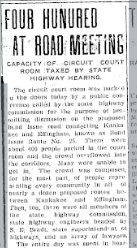
On April 16, 1920, a reported 400 people descended upon the courthouse in Urbana to attend a public hearing held by the state highway commission regarding the proposed State Bond Route 25 (Courier). Attendees came from every community from Kankakee to Effingham that had a stake in the project. A spokesperson for each group was allowed 15 minutes to advocate for the route to come through their community.
“J. C. Thorpe, president of the Urbana Chamber of Commerce, looked after Urbana’s interests,” the paper reported. Thorpe’s proposal called for a route “entering Urbana on the Rantoul road and thence crossing to Champaign to connect with the Egyptian trail southward.”
“Champaign wants the route to follow the Egyptian trail, entering Champaign on North Market Street and going out on South Neil,” the article continued, noting that while no decisions were made, there seemed to be, at the time, “an undercurrent of sentiment” in favor of keeping with the existing Egyptian Trail route. That sentiment would prove short-lived.
The final decision on the highway’s route through C-U finally came in 1922, when “state highway officials agreed to bring Route 25 through Urbana if the city would build ‘an adequate trunk highway through the city’” (Tom Kacich, “The dirt on C-U’s first highway,” News-Gazette, June 14, 2015; the internal quote is from the Courier, Nov. 21, 1922, under the page 1 headline, “Urbana Lands Route No. 25”). Urbana voters approved a $30,000 bond issue to fund the improvements which brought the highway east from Champaign to Urbana via its current route along Springfield and University Avenues.
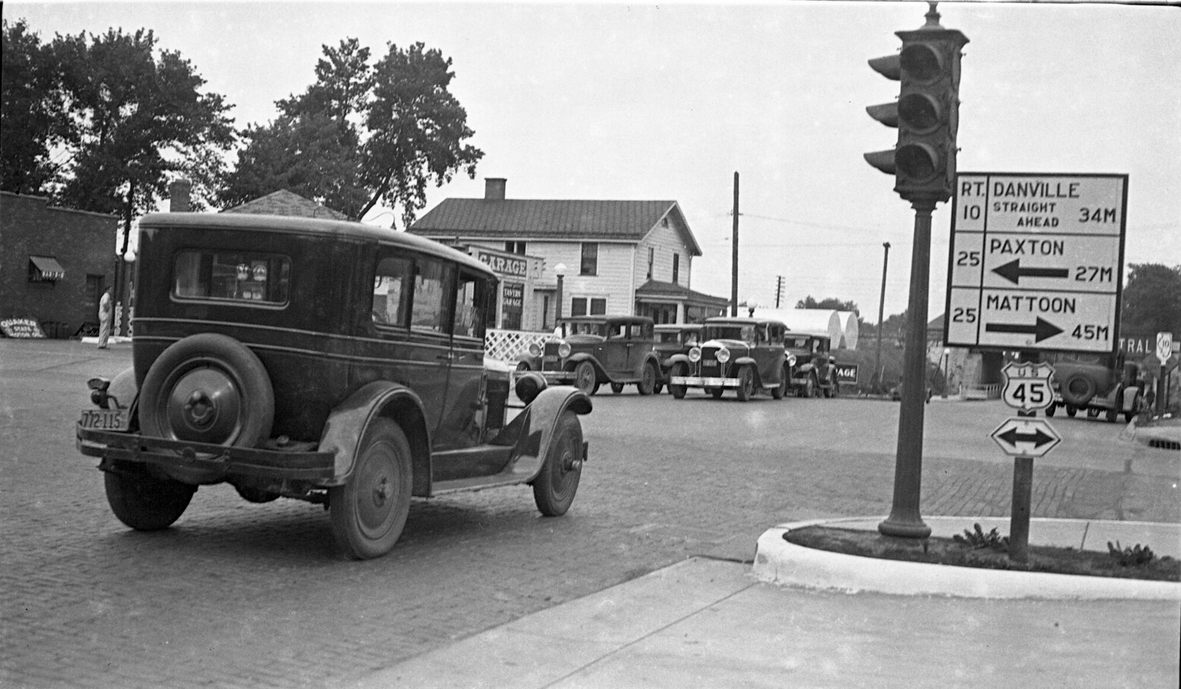
By 1920, sections of the old trail from Pesotum through Tolono to Savoy and from Thomasboro through Rantoul and Ludlow were changed to parallel the railroad more closely. The Egyptian Trail officially become State Route 25 from Kankakee to Effingham in 1924. By 1930, highway maps began to change the designation to U. S. Highway 45. In Part Three of this series, we’ll trace the route the Egyptian Trail followed through the county in its various iterations.